
When your pine trees reach maturity — typically 25 to 35 years old — you have a decision to make. The standard advice is to clearcut (remove every tree from the site) and then spend $300 or more per acre replanting with nursery-grown seedlings. That’s the conventional playbook, and it works — if you’re prepared to make that investment. But a lot of landowners aren’t, and for good reason.
If you’re not going to spend $300+ an acre replanting after a harvest, don’t clearcut. Instead, leave your best trees standing, use prescribed fire to prepare the ground, and let them seed the next generation. You’ll net nearly the same cash at harvest, put a fraction of the capital at risk, get better wildlife habitat immediately, and have a working pine stand regenerating behind you — no replanting check required. If you want to talk through how this might work on your property, schedule a free consultation.
That’s the short version. Here’s the long one.
In a previous article, we walked through what happened to the economics of pine plantations when Southern pulp markets collapsed. In the follow-up, we looked at whether investing $300+ an acre in replanting still makes sense — and found that in a lot of markets, the math is genuinely tight.
This piece is about what to do at harvest. The conventional playbook says clearcut and replant. But if you’re not confident the replanting investment pays off, you’re stuck between two bad options: spend money you’re not sure you’ll get back, or clearcut and let the site go to hardwood scrub. NC State Extension puts it plainly: “The practice of letting nature take its course often results in poor stands of low-quality hardwood.”
There’s a middle path — and in many situations, it’s the best play on the table.
Leave your best trees standing
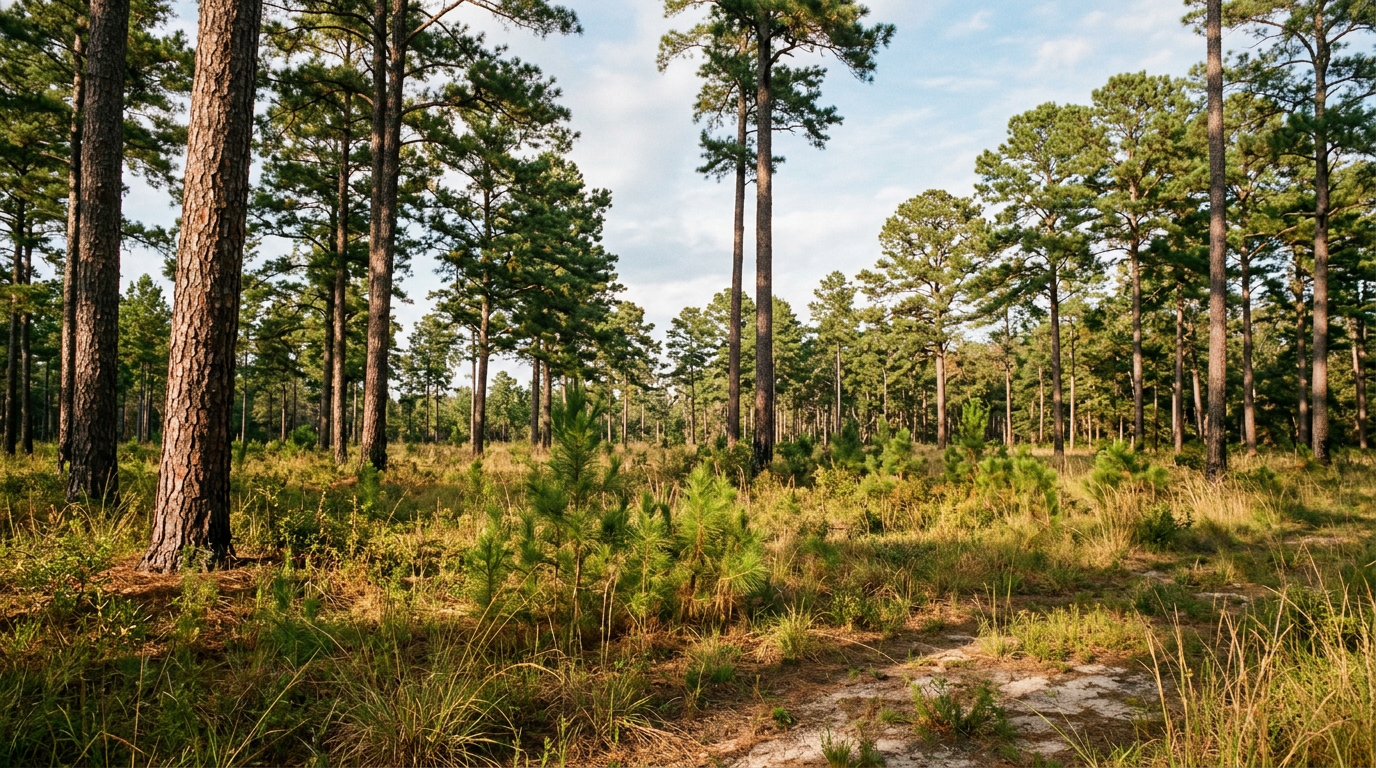
Instead of taking everything, your logger takes most of the stand but leaves 8 to 20 of the best trees per acre — the straightest, tallest, healthiest ones — evenly spaced across the site.
Those trees drop seed. Foresters space seed trees about twice tree height apart — roughly 150 feet between rows for 75-foot trees — so that seed from neighboring trees overlaps to cover the gaps. Downwind, a single loblolly can throw seed 200 to 300 feet. A handful of well-placed trees can seed an entire acre.
Before the seed falls in late October and November, you do a prescribed burn — a controlled, intentional fire set under specific weather conditions. The fire clears logging debris, exposes mineral soil so seed makes contact with the ground, and knocks back competing hardwoods — sweetgum, red maple, privet, all the species that would otherwise overrun the site. Cost: about $35–40 an acre per burn, versus $300–400 for replanting.
Within one to three seed years, you have 300 to 700 pine seedlings per acre establishing naturally. Not in uniform rows — in a variable, patchy pattern that looks more like a natural forest than a plantation. Once the new generation is up, you come back and harvest the seed trees. That’s deferred revenue, not lost revenue.
Foresters call this a “seed tree cut” when you leave fewer trees — six to ten per acre — or a “shelterwood” when you leave more, 15 to 25. The concept is the same: you’re trusting your best trees to do the replanting for you.
What you’re leaving standing — and how you get it back
The practical question: how much money is in those seed trees, and can you actually recover it?
What it costs you upfront. If you leave 10 good sawtimber-quality trees — big enough to cut into boards and lumber — per acre on a stand that would clearcut for $2,000 an acre, you’re deferring roughly $200–400 per acre — about 10 to 20 percent of the total harvest value. Those are your best trees, worth more per tree than average. On 100 acres, that’s $20,000–$40,000 you’re not cashing today.
The removal cut. Once the next generation is established — typically three to seven years, depending on seed crop timing and how quickly seedlings get above browse height — you come back and harvest the seed trees. But here’s the practical concern: is 10 trees per acre enough volume to get a logger to show up?
Honestly, it’s marginal. A mature loblolly at 14–16 inches in diameter yields roughly 1.5–2.5 tons of merchantable wood (wood large enough to sell) — more after a few years of open-grown conditions. At 10 trees per acre, you’re looking at maybe 15–30 tons per acre. On 100 acres that’s 1,500–3,000 tons — enough to justify a crew, but it’s thin. On smaller tracts it’s a harder sell.
The fix: leave more trees. At 15–25 trees per acre, you have substantially more volume for the removal cut — roughly 30–60 tons per acre after a few years of open-grown diameter growth. That’s a real commercial harvest. The extra retained trees also provide more seed, more shade to suppress hardwood competition, and better wildlife cover in the interim. You defer more revenue upfront, but it’s all recoverable.
Can the removal cut double as a thinning? Yes. If regeneration came in dense — 2,000 or more seedlings per acre in spots — the logging equipment during the removal cut will crush some young trees. That’s normally a concern, but here it’s a feature. The logger is doing your pre-commercial thinning — removing excess young trees so the survivors have room to grow — for free. Between the logging disturbance and a follow-up prescribed burn, you get natural thinning at zero incremental cost.
The bottom line on economics. The seed trees aren’t a gift to the forest. They’re a deferred harvest. You recover most or all of that value in the removal cut, plus whatever the trees added in growth during the years they kept standing.
Here’s how the timber economics compare on 100 acres:
| Clearcut + Replant | Leave Seed Trees + Burn | Clearcut + Do Nothing | |
|---|---|---|---|
| Harvest revenue | $200,000 | $160,000–180,000 | $200,000 |
| Replanting cost | -$30,000–45,000 | — | — |
| Site prep (burning) | — | -$3,500–4,000 | — |
| Net at harvest | $155,000–170,000 | $156,000–176,500 | $200,000 |
| Removal cut (years 5–10) | — | +$5,000–17,000 | — |
| Capital at risk | $30,000–45,000 | $3,500–4,000 | $0 |
| What grows for next harvest | High-volume plantation | Pine-dominant mosaic | Low-value hardwood scrub |
The clearcut-and-do-nothing column puts the most cash in your pocket today. But it dead-ends. In 30 years you have scrub where you used to have productive pine ground, and your next merchantable timber harvest is decades away.
The seed tree column nets nearly as much as clearcut-and-replant at harvest — sometimes more, because you’re not writing a $30,000–45,000 check for replanting. You put an order of magnitude less capital at risk. And you have a working pine stand regenerating behind it, plus the removal cut revenue still to come.
The clearcut-and-replant column produces the most controlled, highest-volume next-generation stand. But it requires the most upfront capital and bets heavily on timber markets cooperating across the full rotation. If markets cooperate, it wins on timber long-term. If they don’t — as we saw in the first article — that $30,000–45,000 replanting investment is at risk.
Your best trees aren’t a seed orchard — but they’re not bad
Your best trees won’t match seed orchard genetics — improved seedlings produce 20–35% more volume. But USDA Forest Service research found that natural regeneration preserves significantly more genetic diversity than planting, and these trees are proven on your site. In uncertain markets and a changing climate, local adaptation has real value.
The wildlife upside
A mosaic stand — variable spacing, mixed ages, open understory — is dramatically better habitat than a uniform plantation. Research on thinned and burned pine documented a 38-fold increase in deer carrying capacity. Quail, turkey, and deer all thrive in exactly the structure this approach creates. For landowners who hunt or lease hunting rights, that translates to $5–15 per acre per year in lease revenue — $500–1,500 a year on 100 acres, starting now rather than 25 years from now.
Fire makes it work
Prescribed fire is the key to this approach. Without it, hardwoods win. Burn for four to five years before harvest to control understory competition and prepare the seedbed. Burn after harvest but before seed fall in late October or November. Then continue on a two-to-four-year rotation as regeneration establishes.
Fire also handles the “too many seedlings” problem. If regeneration comes in dense, a burn thins naturally — the survivors are the most vigorous, the spacing is variable rather than uniform rows, and the seed trees give you another crop every three to five years. The result is waves of seedlings at different stages, mixed with open patches and scattered seed trees. Not a plantation. Not scrub. A working forest with built-in structural diversity — at $35–40 per acre per burn.
If you have longleaf, this is how it was always done. Ninety million acres were managed this way before European colonization. The Stoddard-Neel approach has run productive longleaf on private hunting plantations in the Red Hills of Georgia for over 80 years. Pine straw adds roughly $100 per acre per year, and the NRCS Longleaf Pine Initiative offers cost-share. For loblolly and shortleaf, the same principles apply — leave your best trees, burn, manage with fire.
This isn’t passive — continued burning is essential. But fire IS the management. It controls hardwoods, thins seedlings, maintains habitat, and prepares the seedbed for the next crop. If you’re already on a burn program, the incremental cost is minimal.
The bottom line
If you’re going to invest $300–400 an acre in replanting, clearcut. Give those expensive seedlings full sun and a clean start. That’s the right harvest method for a serious planting investment, and the previous article walks through when that investment makes sense.
If you’re not going to invest in replanting, don’t clearcut. Leave your best trees, burn, and let them do the work. You’ll get a stand that won’t match a planted plantation in raw volume — expect roughly 20–30% less over 30 years — but costs a fraction as much to establish, starts generating wildlife and hunting revenue immediately, preserves genetic diversity, and hedges your bets on markets nobody can predict 15 years out.
The one thing not to do: clearcut and do nothing. That’s converting productive pine ground to decades of low-value hardwood scrub. If you’re not going to replant, give your best trees a chance to do it for you.
A note on regional variation
As with the previous articles, your situation depends on species, site quality, proximity to markets, and whether you have access to a prescribed burning program. The economics above are illustrative — based on south-wide averages and medium site quality. A stand of longleaf in the Red Hills of Georgia is a very different proposition than a loblolly plantation in the Piedmont of Virginia. The specific numbers for your property require looking at your property.
That’s what Forest Forecast is built for — giving you the site-specific picture for your acres. If you want to walk through what the harvest options look like for a particular tract, that’s what a consultation is for.
Schedule a Free Consultation
Sources and assumptions
Stumpage prices and market data. Current south-wide average stumpage prices — approximately $23 per ton for pine sawtimber, $18 for chip-n-saw, and $6 for pulpwood — are from TimberMart-South (TMS) Q4 2025 quarterly reports, as reported by UF/IFAS Extension (January 2026) and Southern Ag Today. The harvest revenue estimates of $1,500–2,500 per acre for mature loblolly stands are derived from these stumpage prices applied to typical per-acre volumes for managed plantations aged 25–35 years.
Seed tree and shelterwood retention. Seed tree retention of 6–14 trees per acre with spacing of 60–104 feet is from Stephen F. Austin State University, “Regeneration Methods: Seed-Tree.” Mississippi State Extension recommends 6 seed trees per acre for loblolly with an additional 2–4 as insurance, bringing practical recommendations to 8–10 per acre. Shelterwood retention of 20–35 trees per acre for longleaf is from UF/IFAS Extension, “Longleaf Pine Regeneration” (FR064), and USDA Forest Service Southern Research Station longleaf regeneration research.
Seed distribution and regeneration targets. The seed tree row spacing guideline of twice tree height for loblolly pine is from Mississippi State Extension and SFA Silviculture. The effective seeding distance of 200–300 feet downwind and 75–100 feet in other directions is from the USDA Forest Service Silvics of North America (Pinus taeda). The target of 300–700 well-distributed seedlings per acre after three growing seasons is from Mississippi State Extension and SFA Silviculture, with 1,000–3,000 seedlings per acre as the first-year target.
Establishment costs. Prescribed burning costs of $31.88–38.29 per acre, mechanical site preparation at $172.83 per acre, hand planting at $133.92 per acre, chemical site preparation at $89.64–93.47 per acre, and pre-commercial thinning at $139 per acre are from Maggard, Murphy, and Pullalarevu (2024), “Costs and Trends of Southern Forestry Practices,” Alabama Cooperative Extension System. The total replanting cost range of $300–450 per acre is derived from these component costs.
Genetic gains. Volume gains of 20–35% for second- and third-generation improved seedlings over unimproved stock are from the NC State Cooperative Tree Improvement Program and McKeand, Payn, Heine, and Abt (2021), “Economic Significance of Continued Improvement of Loblolly Pine Genetics,” Journal of Forestry 119(1):62–72. Family heritability values of 0.82–0.90 for loblolly pine growth traits are from USDA Forest Service research. The estimated 5–15% gain from phenotypic selection of seed trees is the author’s inference based on these heritability values. The finding that natural regeneration preserves superior genetic diversity (more alleles per locus, reduced inbreeding) compared to artificial regeneration is from USDA Forest Service research on shortleaf pine (Pinus echinata), “Regeneration Methods Affect Genetic Variation and Structure in Shortleaf Pine” (Treesearch 1448).
Natural regeneration versus planted stands. The observation that planted stands with improved genetics outperform natural regeneration by approximately 20–30% in volume over a full rotation is the author’s estimate based on the genetic gain literature and NC State Extension’s comparison of naturally regenerated versus planted stand volumes. NC State Extension notes that “managing over-stocked natural stands can equal or exceed the costs of site preparation and planting in the long-run.” The statement that natural regeneration produces less merchantable volume is consistent with USDA Forest Service research showing planted genetically improved stock producing roughly twice the volume of naturally regenerated stands at early ages (Cain and Barnett 1994, New Forests), with the gap most pronounced at mid-rotation when many naturally regenerated stems have not yet reached merchantable diameter thresholds. By rotation age (25–35 years), the gap narrows primarily to the genetic component.
Prescribed fire effects. The three-burn protocol for seedbed preparation is documented in Great Lakes Silviculture Library research. The finding that growing-season fires are most effective at controlling woody hardwood competition is from the Longleaf Alliance and USDA Forest Service. Loblolly seedling mortality of 64–70% from prescribed fires applied after the second growing season is from research at Fort Benning and Camp Lejeune. In Kisatchie National Forest, 52–86% of post-fire pine regeneration was from sprouts, with 92–100% being shortleaf pine. Longleaf grass-stage fire resistance is well documented across the longleaf pine literature.
Wildlife. The 38-fold increase in deer carrying capacity (from 7 to 268 deer days per hectare) in thinned and burned pine stands is from Mississippi State Natural Resource Enterprises. The 26 bird species of conservation concern requiring structural complexity in longleaf systems is from USDA Forest Service Southern Research Station, “Ecological Forestry, Old Growth, and Birds in the Longleaf Pine Ecosystem.” Hunting lease rates of $5–15 per acre per year are from regional forestry extension estimates for the southeastern United States.
Longleaf pine. Pre-colonization extent of 90 million acres is from the USDA Forest Service. The Stoddard-Neel approach is documented in “The Art of Managing Longleaf” (UGA Press) and Tall Timbers Research Station publications. The shelterwood method for longleaf — preparatory cut to 60–70 sq ft per acre basal area, seed cut leaving no more than 30 sq ft per acre — is from UF/IFAS Extension (FR064) and USDA Forest Service Southern Research Station. Pine straw revenue of approximately $100 per acre per year is from Alabama Cooperative Extension. The NRCS Longleaf Pine Initiative provides cost-share assistance for longleaf restoration on private lands.
Removal cut as pre-commercial thinning. The observation that logging equipment during the removal cut can serve as a de facto pre-commercial thin is explicitly stated in SFA Silviculture (Stephen F. Austin State University): “The equipment moving over the seedlings can also double as a pre-commercial thinning for the new cohort” (Shelterwood chapter), and “Damage should be minimized where possible, unless a precommercial thin is also prescribed” (Seed-Tree chapter). Tesch et al. (1986), “Mortality of Regeneration During Skyline Logging,” Journal of Forestry 84(6):49–50, documented approximately 44% total seedling mortality during removal operations. SFA Silviculture notes that even 80% seedling damage during the removal cut still leaves adequate stocking if the initial regeneration target of 3,000–6,000 seedlings per acre was achieved. The “corridor thin” — 15-foot corridors at 60-foot spacing — is described in SFA Silviculture as “the most common type of geometric thinning in naturally regenerated stands.” Clemson Extension, “Pre-commercial Thinning: An Answer to a Problem of Too Much Success” (2021), identifies 2,000 seedlings per acre as the threshold above which PCT is recommended, with a target of 500–700 well-distributed stems per acre.
Scenario modeling. The Year 0 cash flow comparison table (clearcut + replant, leave seed trees + burn, clearcut + do nothing) uses the stumpage prices, establishment costs, and retention percentages described above, applied to 100 acres of mature loblolly pine at SI 65–70 on Coastal Plain site conditions. Removal cut revenue of $5,000–17,000 on 100 acres assumes 15–25 retained seed trees per acre harvested at 1.5–3 tons per tree at current sawtimber stumpage, with per-tree tonnage reflecting 14–16+ inch DBH trees after several years of open-grown conditions. These are illustrative estimates, not site-specific projections.