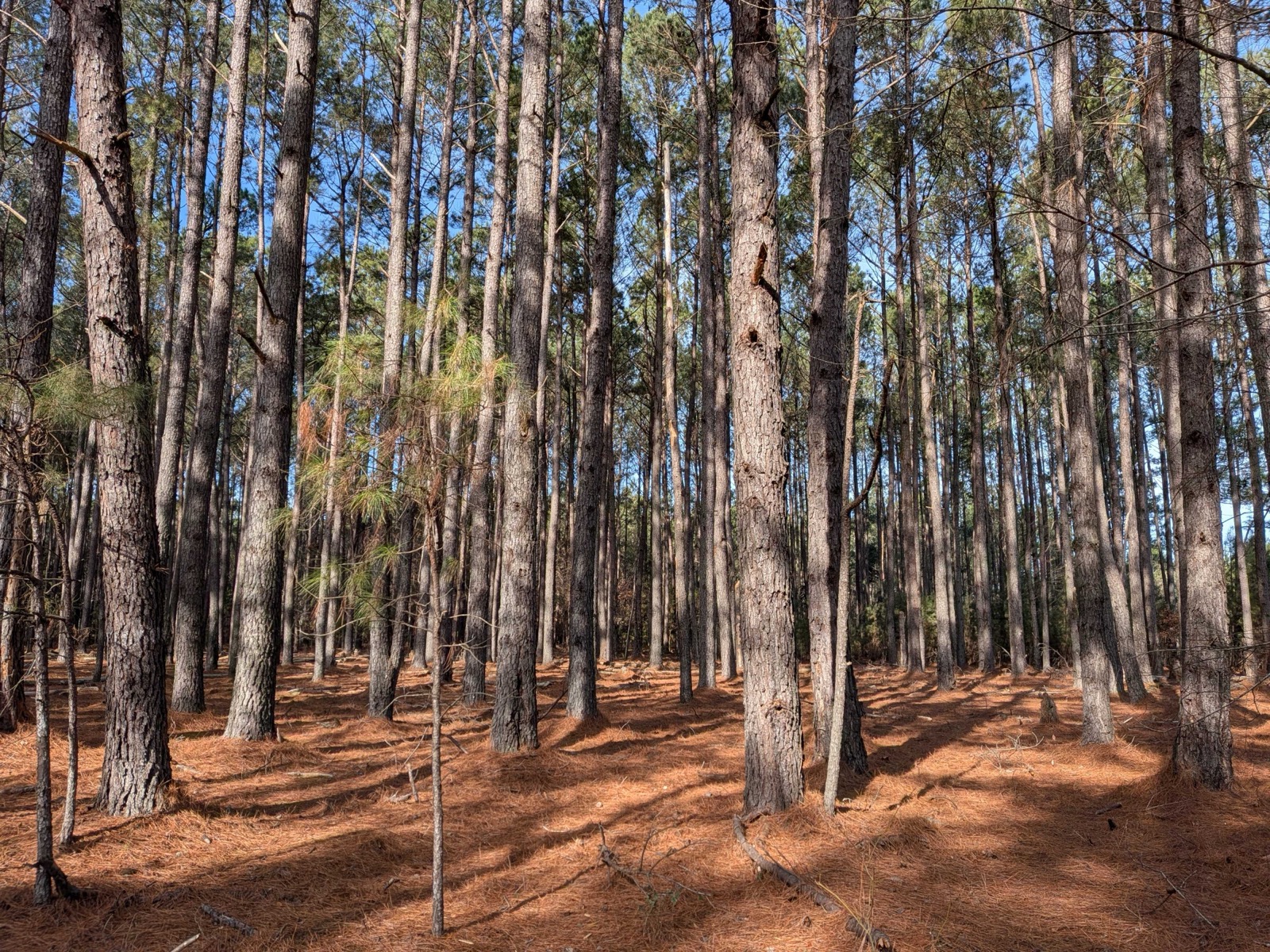

Ten years ago, planting loblolly pine was one of the most reliable long-term investments a rural Southern landowner could make. Plant 500–600 trees per acre on decent ground, thin at 15, maybe again in the mid-20s, clearcut in the late 20s to early 30s, and walk away with a 7–9% return. Competitive with the stock market, backed by a tangible asset, repeatable for generations.
That story is broken, and some landowners have lost over 50% of the earning potential of their forest.
The trees are growing as promised. The problem is that the infrastructure those trees were supposed to feed — the pulp mills, the chip markets, the buyers who were supposed to show up at year 15 with a check — is gone. And the consequences of that disappearance are far worse than most people realize.
The plan you were sold
A typical loblolly plantation on decent Coastal Plain ground, planted around 2016, looked like a sound investment.
- You’d spend about $250 an acre to get 500 to 600 trees in the ground — site prep, seedlings, planting — and another $7 an acre per year to keep them managed: prescribed burns, taxes, basic oversight.
- At year 15, thin out the smaller stems — all pulpwood to be turned into paper products, worth about $9 a ton — and pocket $250–300 an acre.
- Maybe thin again in the mid-20s, pulling out a mix of pulpwood and mid-size logs that might make some 2x4s, worth more per ton.
- Then clearcut in the early 30s, when the big sawtimber — worth nearly three times what pulpwood fetched — made up the bulk of the harvest.
The expected payout on that final cut alone was north of $2,300 an acre. Over the full 33-year rotation, a well-managed stand was projected to net around $2,900 an acre after all costs — an annual return of roughly 7–9%, competitive with the stock market, on land you could still hunt on.
On 100 acres, that was close to a quarter-million dollars. Real, repeatable, and backed by a physical asset.
The trees held up their end. They grew as promised. What broke was the market they were supposed to grow into.
What actually happened
Between 2023 and 2025, the Southern pulp and paper industry didn’t just weaken — it structurally collapsed. More than 10 major pulp facilities closed in three years, removing over 25 million tons of annual fiber demand from the market. Nationwide, dozens of paper mills have shut down over the past decade.
The price data tells the story. South-wide average pine pulpwood stumpage in late 2025 was $5.96 a ton — down 46% from 2022. In South Carolina it hit $5.00. In parts of Arkansas, southern Louisiana, and southeast Texas, it’s below $4. And those are averages. In areas near closed mills, the effective stumpage price is zero — there’s no buyer within economical hauling distance.
It’s not just lost thinning revenue
This is where most casual analyses understate the damage. People look at the collapse and think: “Okay, so you lose $250–$300/acre on the first thinning. That’s bad but survivable.” But the damage compounds through the entire rotation in ways that turn a setback into a catastrophe.
The first-thin revenue flips from positive to negative. That $250–300/acre of expected income at year 15 becomes $0–100 if you can find a buyer. If you can’t sell the pulpwood at all, you’re looking at paying $150–250/acre for a pre-commercial thin — a logger felling trees and leaving them on the ground, with you writing the check instead of cashing one. That’s a $400–550/acre swing from the original plan on a single operation.
If you can’t thin at all, the sawtimber timeline gets wrecked. This is the real damage. Thinning doesn’t just generate revenue from the trees you remove — it fundamentally changes what the trees you keep grow into. University of Georgia research on thinned versus unthinned stands makes the contrast stark: in a properly thinned stand, nearly two-thirds of the final harvest volume is chip-n-saw and sawtimber — the wood that’s actually worth money. In an unthinned stand, that ratio flips. Over 60% of the volume is pulpwood — the product class that currently has no market.
Without thinning, you’re not just losing the thinning revenue. You’re growing an entire stand of the wrong product.
What your stand becomes
Harvest value at age 24 — thinned at 15 vs. never thinned
Pulpwood price: $6/ton
Volume data: Dickens et al., UGA Warnell School — GaPPS 4.20 model, SI 63, base age 25. CNS and ST prices at approximate 2025 TMS south-wide averages.
Across the South right now, this is playing out in real time. Foresters describe the same scenario over and over: a landowner with 100 acres of 16-year-old planted pine, diameter growth stalled, knowing a thin is needed, calling a logging company — and being told they can’t move the timber because the buyers are gone.
Unthinned stands don’t just underperform — their risk of total loss dramatically increases. Overstocked pine is more vulnerable to southern pine beetle, drought, and other disturbances. The longer the thinning is delayed, the more the risk compounds. For many landowners, this is indefinite postponement — and every year the stand sits overstocked, the odds of losing it entirely go up.
The new math
Here’s what the same investment looks like when the pulp market disappears.
Scenario A: can thin, but pulp markets pay less
The first thin happens, but at near-breakeven stumpage prices — at $5–6/ton, loggers can barely make the economics work, and some won’t buy at all. Sawtimber prices are softer too. The product mix degrades because economic pressure forces imperfect thinning decisions.
| Event | Year | $/Acre |
|---|---|---|
| Establishment | 0 | -$250 |
| Carrying costs | 1–33 | -$231 |
| 1st thin | 15 | +$50 |
| 2nd thin | 24 | +$350 |
| Final harvest | 33 | +$1,800 |
| Net revenue | ~$1,720/acre |
On 100 acres: roughly $172,000 — about $120,000 less than initially expected. After inflation, your real return drops to about 3%. Less than half what a basic index fund returned over the same period.
Scenario B: can’t thin at all
No buyer for the pulpwood. Can’t afford a pre-commercial thin. The stand stagnates, the rotation stretches, and mortality risk climbs every year.
| Event | Year | $/Acre |
|---|---|---|
| Establishment | 0 | -$250 |
| Carrying costs | 1–36 | -$252 |
| 1st thin | — | $0 |
| 2nd thin | — | $0 |
| Final harvest | 33–36 | +$900–$1,200 |
| Net revenue | ~$400–700/acre |
On 100 acres: roughly $40,000–70,000 — a quarter-million dollars less than initially expected. In real purchasing power after 33 years of inflation: $15,000–35,000. A savings account would have done better.
The revised math: 100 acres over 33 years
Net revenue after all costs — what the same investment returns under three market scenarios
Original Plan
Net: $292,000
Real return: 5.5%
Scenario A
Can Thin, Broken Markets
Net: $172,000
Real return: ~3%
−$120,000 vs. plan
Scenario B
Can't Thin at All
Net: $40,000–$70,000
Real return: < 0%
−$222,000–$252,000 vs. plan
Based on Dickens et al. (2017) rotation framework with current (2025–26) TMS stumpage prices. SI 65–70, 500–600 TPA, Coastal Plain conditions. See Sources and Assumptions for detail.
What this means for a real person
Put a face on those numbers. Consider a landowner with 100 acres in coastal South Carolina who planted pine around 2016 — maybe as part of a retirement plan expected to net close to $290,000 over 33 years. Depending on whether they can find a buyer for a thinning, they’re now looking at somewhere between $170,000 and $40,000. The difference is a paid-off house. A kid’s college fund. A retirement that works versus one that doesn’t.
The structural trap
What makes this particularly painful is the lock-in. The traditional model — 500+ trees per acre, thin at 15 and mid-20s, harvest in the early 30s — doesn’t work without functioning pulp markets. But if you planted ten years ago under that model, you can’t go back and unplant 200 trees per acre. You play the hand you’re dealt.
This is the landowner’s dilemma — and forest management’s fundamental challenge. We make decisions today that take decades to play out, and nobody has a crystal ball. “Grow it and they’ll buy” probably felt like a good bet in 2016.
The Southern timber economy was built on a three-legged stool: sawtimber, chip-n-saw, and pulpwood. One of those legs is broken. Until it’s replaced — whether by biomass energy, wood pellet exports, cross-laminated timber, or something nobody has thought of yet — the economics of pine plantation forestry in much of the South are fundamentally different from the ones landowners had planned for.
The forward-looking advice is: if you’re planting today, plant wider, plan for fewer thinnings—if any—and plan for flexibility. But this is also a moment to reconsider several elements of the ingrained rotation model itself. In subsequent articles, we’ll dig into the best moves going forward and how to plan despite unpredictable markets.
A note on regional variation
Your situation isn’t identical to the one described here — it never is. The specific rotation we walked through assumes two thinnings, which not everyone plans for. Your stumpage prices, hauling distances, and site quality are different. The numbers above are illustrative, not a prescription.
But the underlying story probably rings true across most of the pine-growing South. The areas hit hardest — coastal South Carolina, eastern and southwest Georgia, eastern North Carolina, and parts of Alabama and the Florida panhandle — have seen multiple mill closures overlap. In areas where pulp markets are weakened but still functioning, the picture is less dire. Pulpwood prices and availability can vary enormously over distances of 50 miles.
If you’re trying to assess your own situation, the single most important question is simple: is there a functioning pulpwood market within economical hauling distance of your tract — and will it still be there in the years when your stand needs thinning?
Want to talk about your timber and potential options?
Schedule a Free Consultation
Sources and assumptions
Stumpage prices and market data. Pine pulpwood and sawtimber stumpage prices are from TimberMart-South (TMS) quarterly reports, as reported by UF/IFAS Extension (January 2026) and Clemson Extension Forestry (Q2 and Q3 2025). The south-wide average of $5.96/ton for pine pulpwood and the 46% decline from the 2022 peak are Q4 2025 TMS figures. State-level prices (South Carolina at $5.00–5.70/ton, sub-$4 in Arkansas, Louisiana, Tennessee, and southeast Texas) are from the same TMS reporting period.
Mill closures. The Georgetown, SC closure (International Paper, late 2024, ~700 jobs) was widely reported; job figures are from the Post and Courier. The Savannah and southeastern Georgia closures (IP, August 2025, ~1,100 jobs) are from IP’s public announcements and WRDW reporting. The Cedar Springs, GA closure (Georgia-Pacific, August 2025, 535 jobs) is from GP’s May 2025 announcement; the $182 million annual economic impact figure is from a consultant’s report presented to the Early County Board of Commissioners, as reported by Georgia Public Broadcasting (August 2025). The “more than 10 major facilities” and “25 million tons of demand removed” figures are from UF/IFAS Extension, citing Forisk Consulting data.
Rotation economics and product-mix data. The baseline 33-year, two-thin rotation economics (establishment costs, carrying costs, per-acre net revenue, IRR) are derived primarily from Dickens, Li, and Moorhead (2017), “Loblolly Pine Rotation Age Economic Comparisons Using Four Stumpage Price Sets,” University of Georgia Warnell School of Forestry and Natural Resources. The thinned versus unthinned product-mix comparison (92 tons PW / 54 CNS / 5.4 ST unthinned vs. 57 PW / 73 CNS / 22 ST thinned at age 24) is from Dickens et al., “A Guide to Thinning Pine Plantations,” UGA Warnell School, using GaPPS 4.20 growth and yield modeling at SI 63 (base age 25).
Scenario modeling. Scenarios A and B are the author’s projections based on current TMS stumpage prices applied to the Dickens et al. rotation framework. They assume SI 65–70 (base age 25), 500–600 TPA initial planting density, and Coastal Plain site conditions. Carrying costs assume $7/acre/year for taxes and management. These are illustrative estimates, not site-specific projections.