
In a previous article, we walked through what happened to the economics of pine plantations when Southern pulp markets collapsed. That piece was about stands already in the ground — plantations established under assumptions that no longer hold.
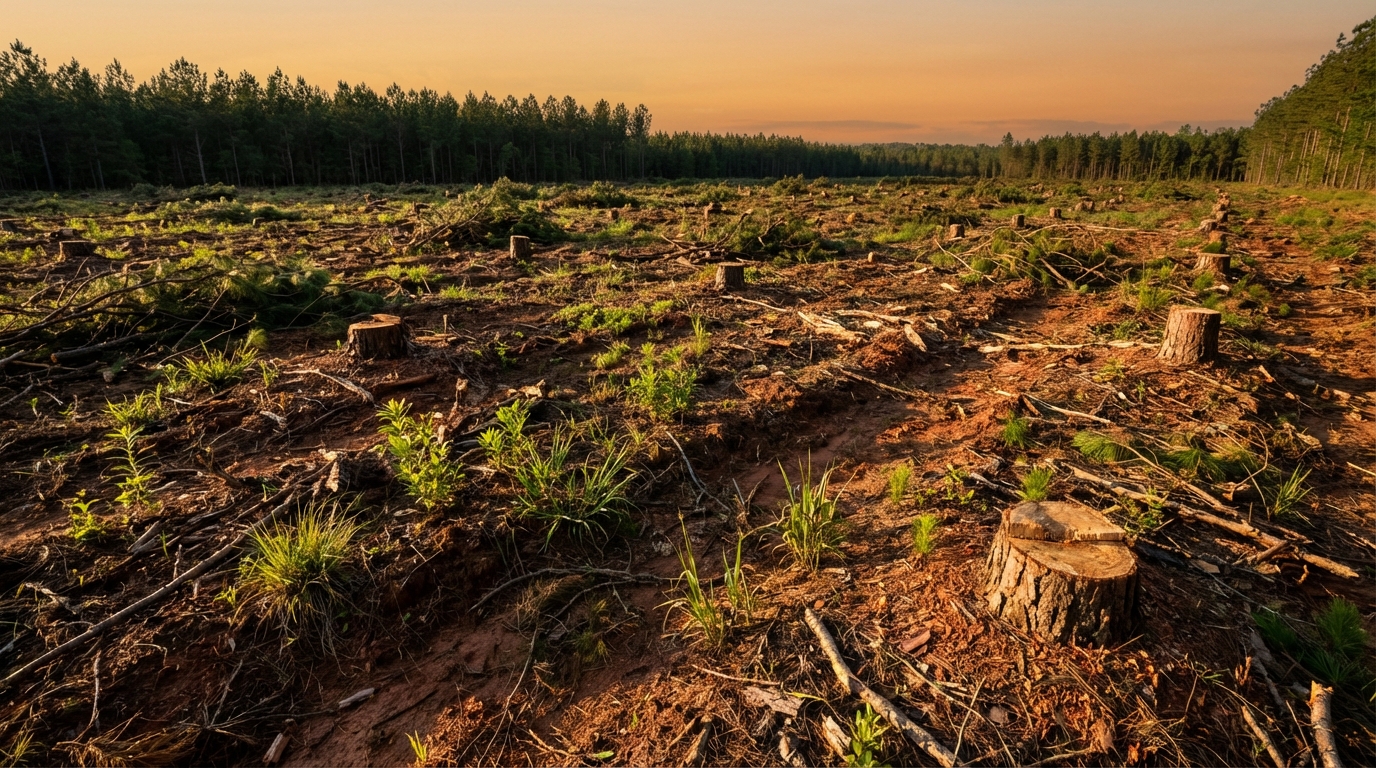
This one is about the forward-looking question. You’ve got a cleared site — a recent harvest, a field you’re converting, storm damage, whatever brought you here — and you’re deciding what to do with it. In many places in the South planting pine is the conventional answer, and for many landowners it’s still the right one. But “plant pine” isn’t one decision. It’s a series of decisions about how much to invest and what you’re optimizing for, and those decisions look different than they did twenty years ago.
Here’s how I’d think through it.
Start with the opportunity cost
Say you’ve got 50 acres of cleared ground. A lean pine establishment — improved seedlings, chemical site prep, hand planting — runs about $200 an acre. On 50 acres, that’s $10,000. Go more intensive with bedding, fertilizer, and elite genetics, and you’re looking at $475 an acre — $23,750.
That’s real money, and it’s money that has alternatives. The simplest one: a 30-year U.S. Treasury bond, currently yielding about 4.7%. Put $10,000 in a 30-year treasury and you’ll have roughly $40,000 at maturity. Put $23,750 in and you’ll have about $95,000. No risk (fingers crossed). No weather. No beetles.
This isn’t an argument against planting pine. It’s a baseline. Any investment you make in your land should be compared against what that same money could do sitting in another instrument. And yes, it’s true that you can’t watch a sunset from or hunt on a treasury bond — but just because you don’t plant pine doesn’t mean you can’t enjoy your land too. Twenty years ago, pine returned 7–9% on well-managed ground — roughly double the treasury rate. That difference made pine an easy call. Today, the treasury rate is about the same as it was then, but expected timber returns are lower. Which means the decisions about how you establish a pine stand might need to be reconsidered.
The goal isn’t to beat the treasury by a mile. It’s to understand what combination of practices, on your ground, gives you a return that justifies tying up your money for 30 years in something that carries real risk.
The land appreciates whether you plant or not
One thing worth separating: the land and the timber are different investments.
Land prices across the rural South have climbed steadily even as timber values softened. Your 50 acres appreciates whether you plant pine on it or not. The old pitch — that timber is a “real asset” and an inflation hedge — has a kernel of truth, but the inflation hedge was always the land. The ground itself, valued for hunting, privacy, recreation, and legacy, is what appreciates. A naturally diverse mix of hardwood and pine growing back on its own might actually be better habitat and more attractive to a future buyer than a monoculture pine block.
This matters because it reframes the question. You’re not choosing between “productive land” and “idle land.” Woody vegetation is going to grow on that cleared site whether you spend money or not. What you’re really deciding is whether to invest $12,500–$22,500 to control what grows and how fast — and whether that control will pay for itself over the next three decades.
The palette of investment
Pine establishment isn’t one-size-fits-all. There’s a gradient of intensity, from minimal intervention to full-scale plantation silviculture, and each level comes with different costs, different assumptions about markets, and different risk profiles.
Here’s what’s on the table, roughly ordered from smallest to largest investment per acre.
Genetics: the cheapest lever with the biggest upside
Open-pollinated loblolly seedlings from a state nursery run $66–120 per thousand. Mass control pollinated (MCP) seedlings — where both parent trees are selected for performance — run about $165 per thousand. At 450 trees per acre, that’s roughly a $20–45 per acre premium for MCP over standard open-pollinated stock. On 50 acres, the difference is $1,000–2,250.
For that money, the research is compelling. NC State’s Cooperative Tree Improvement Program reports volume gains of 35–40% for MCP families over unimproved stock. But the product mix shift might matter even more than the raw volume: in ArborGen’s 20-year field trial in South Carolina, MCP stands showed roughly 90% sawtimber potential — meaning nine out of ten trees grew large enough to cut into boards and lumber — versus about 20% for the open-pollinated comparison.
That’s a striking difference. Sawtimber (trees big enough for boards and lumber) is where the money is in today’s markets. Pulpwood (smaller trees that go to paper mills and chip plants) has collapsed in many parts of the South. So the genetic quality of your seedlings has an outsized effect on what you end up with at harvest. Better genetics means straighter stems, faster diameter growth, and a higher percentage of trees that grade into the product classes that actually have buyers.
Of everything on this list, genetics is probably the single best dollar-for-dollar investment. The premium is small relative to total establishment cost, the payoff compounds over the full rotation (the full cycle from planting to final harvest), and it doesn’t depend on pulp markets. If you’re going to plant at all, plant good trees.
Density: the decision that shapes your whole rotation
How many trees you put in the ground per acre is the single biggest factor in what your stand needs from markets over the next 30 years.
The traditional prescription is 545–680 trees per acre (8×8 to 8×10 spacing). At that density, the stand will need at least one commercial thinning to stay healthy — trees compete for light and resources, and without thinning, diameter growth stalls and you end up with a stand that’s mostly small-diameter wood. That first thinning is almost entirely pulpwood. When pulp markets were functioning, it generated $250–300 an acre. Today, depending on where you are, it might generate nothing — or cost you money.
At 300–450 trees per acre (10×10 to 12×12 spacing), the picture changes. Each tree gets more growing space from day one. Diameter growth is faster. Clemson Extension’s 2025 analysis found that at 12×12 spacing — about 300 trees per acre — stands yield nearly twice the sawtimber volume of tighter-spaced stands at age 25. The stand reaches sawtimber size classes without a mandatory commercial thin, or with an optional thin that’s a bonus rather than a requirement.
The tradeoff: lower density means fewer total tons of wood per acre over the rotation. You’re concentrating growth into fewer, bigger trees rather than growing the most total wood per acre. In a world where all product classes had strong markets, that was a sacrifice. In a world where sawtimber is the product class with reliable demand and pulpwood is uncertain, it looks more like a feature.
This is a market bet either way. Higher density bets that thinning markets — pulp, biomass, pellets, something — will be there when you need them in 12–18 years. Lower density bets that sawtimber markets hold and that you don’t need thinning revenue to make the rotation work. Either bet could be right. But you should know which one you’re making.
Chemical site prep: survival insurance
Herbicide for site preparation — knocking back competing hardwood and brush before planting — runs about $106 an acre. First-year herbaceous weed control adds another $67. Together, call it $175 an acre.
This is the closest thing to a no-brainer in the whole establishment package. Competing vegetation is the number-one killer of planted seedlings in the first three years. You can spend money on the best genetics and perfect spacing, but if your seedlings get overtopped by sweetgum and privet in year two, none of it matters.
Chemical site prep isn’t an acceleration bet or a market bet. It’s survival insurance. If you’re going to spend money putting trees in the ground, spending another $175 an acre to make sure they live is the most defensible line item in the budget.
Bedding: site-specific, not universal
Bedding — creating raised planting rows with a bedding plow — costs about $157–163 an acre. On poorly drained Coastal Plain sites, it can be transformative: raising the root zone above the water table, improving early survival, and accelerating growth in the critical first few years.
On well-drained upland sites, it does very little. This is a practice that pays for itself in specific soil conditions and is wasted money in others. If you’re on flat, wet ground in the lower Coastal Plain, bedding probably belongs in your budget. If you’re in the hills with decent drainage, skip it.
Fertilization at establishment: an acceleration bet
Applying fertilizer — at planting costs about $114 an acre. On phosphorus-deficient soils, the growth response can be substantial: UGA research has documented 32% volume increases at year 8 from phosphorus application on responsive soil groups, with the growth boost lasting 15–20 years.
But this is an acceleration bet. You’re spending more now to grow trees faster. That improves your yearly return if the timber has a buyer at a price that justifies the upfront cost. On responsive sites with strong sawtimber market access, fertilization probably pencils. On marginal sites or in areas where you’re less confident about 30-year market access, it’s the kind of expense you might defer.
Mechanical site prep: the high-cost option
Mechanical site preparation — basically heavy equipment clearing the site — runs about $160–200 an acre. It physically removes stumps, roots, and debris to give your planted seedlings a clean start.
Combined with chemical prep, bedding, and fertilizer, full mechanical site prep pushes total establishment cost toward $450 an acre or higher. NC State Extension’s analysis shows this high-investment approach can nearly double what a stand is worth in today’s dollars on productive sites — $846 per acre versus $433 for a seedlings-and-planting-only approach on high-quality ground.
But that comparison assumes functioning markets for all product classes across the full rotation. The high-investment approach has the highest ceiling and the most to lose if markets don’t cooperate. It’s the right call on your best ground with the best market access. It’s a risky bet on marginal ground with uncertain markets.
Putting it together
Here’s what the total investment looks like across four approaches, all on 50 acres:
| Natural Regen | Lean | Moderate | Intensive | |
|---|---|---|---|---|
| Seedlings | None | Improved OP ($90/M) | MCP ($165/M) | MCP ($165/M) |
| Density | Whatever comes up | ~300 trees/acre | ~450 trees/acre | ~550 trees/acre |
| Site prep | None | Chemical only | Chemical + herbaceous | Chemical + mech + bedding |
| Fertilizer | No | No | No | Yes |
| Planting | None | Hand, bareroot | Hand, bareroot | Hand, bareroot |
| Est. cost/acre | $0 | ~$200 | ~$310 | ~$475 |
| 50-acre total | $0 | ~$10,000 | ~$15,500 | ~$23,750 |
| Thinning plan | N/A | None needed | Optional (1) | Requires 1–2 |
| Primary market bet | None | Sawtimber | Sawtimber | Sawtimber + pulp/fiber |
How the math changes with your assumptions
Adjust site quality and market outlook — see which approaches clear the treasury bar on 50 acres
Costs from Maggard et al. (2024). Volumes informed by Dickens et al. (UGA) and Clemson Extension (2025). Treasury at 4.7% (Feb 2026). Medium site = SI 65, Coastal Plain. See Sources and Assumptions for detail.
What the numbers actually look like
Here’s the part that matters. For each approach, what does the timber return look like over 30 years on a medium-quality site — and how does it compare to putting that same money in a treasury bond?
I’ll use current south-wide average stumpage prices — what a buyer pays for standing timber, before harvesting costs: about $23 per ton for pine sawtimber, $18 for chip-n-saw (mid-size logs, bigger than pulpwood but not large enough for full lumber), and $6 for pulpwood. Carrying costs of $7 an acre per year for taxes and basic management.
But before you jump to the biggest number, pay attention to two things: what each dollar of investment returns, and what each approach requires from markets to work.
Natural regeneration: $0/acre, let it roll
This is the option most people skip past, but it deserves a real look. What if you don’t spend $10,000–$23,750 on establishment? That money goes into a treasury bond instead and returns $40,000–$95,000 in 30 years. Meanwhile, your land still grows — whatever seed bank is in the soil, volunteer pine from nearby seed trees, sweetgum, poplar, oaks — it all comes up on its own. The land still appreciates. And anything you harvest off the natural stand in 30 years is gravy on top of the treasury return.
What that natural stand looks like depends on what’s nearby. With pine seed trees within a few hundred feet and a good seed year, you can get reasonable pine stocking mixed with hardwood. Without a pine seed source, you’ll get a hardwood-dominant stand — good habitat, but limited timber value. Either way, you might get $100–350 per acre in merchantable wood at year 30, mostly pulpwood and low-grade. Maybe more, maybe less.
| 50 acres | |
|---|---|
| Treasury return (capital preserved) | $40,000–$95,000 |
| Bonus harvest revenue (if any) | $5,000–17,500 |
| Carrying costs (30 yr) | -$10,500 |
| Total return | ~$34,500–$102,000 |
(Note: carrying costs — taxes and basic management — apply to the land regardless of what you do with it. They’re subtracted from the timber scenarios and from the natural regen scenario, but not from the treasury figure, which is a pure capital comparison.)
That’s the real baseline. When you look at the planted scenarios below, the question isn’t just “does planting pine make money?” It’s “does planting pine make more money than the treasury plus whatever grows on its own?” On good ground, the answer is yes. On marginal ground, it’s genuinely close.
Lean approach: ~$200/acre, 300 trees per acre (TPA), no thin
At wide spacing with improved genetics, individual trees reach sawtimber diameter faster and a large share of the stand grades into higher-value product classes without thinning. On a medium site, a reasonable estimate at harvest is 55–70 tons of sawtimber and 20–30 tons of chip-n-saw per acre.
| Per acre | 50 acres | |
|---|---|---|
| Gross harvest revenue | ~$1,600–2,150 | $80,000–107,500 |
| Establishment cost | -$200 | -$10,000 |
| Carrying costs (30 yr) | -$210 | -$10,500 |
| Net revenue | ~$1,190–1,740 | ~$59,500–87,000 |
| Treasury alternative | ~$39,800 |
Estimated annualized return: roughly 5–7% on medium sites, higher on good ground. Beats the treasury with less capital at risk and no dependency on thinning markets. And here’s the number that surprised me: every dollar of establishment cost returns roughly $6–9 in net revenue. That’s the best bang-for-buck of any approach on this list.
Moderate approach: ~$310/acre, 450 TPA, optional thin
Better genetics and more thorough site prep produce higher total volume. If a thinning market exists, you can capture $150–250 per acre at year 15 as a bonus. If it doesn’t, the stand still works — trees are spaced wide enough to reach sawtimber dimensions without a mandatory thin.
| Per acre | 50 acres | |
|---|---|---|
| Gross harvest + optional thin | ~$1,900–2,500 | $95,000–125,000 |
| Establishment cost | -$310 | -$15,500 |
| Carrying costs (30 yr) | -$210 | -$10,500 |
| Net revenue | ~$1,380–1,980 | ~$69,000–99,000 |
| Treasury alternative | ~$61,700 |
Estimated annualized return: roughly 5–7% on medium sites. Beats the treasury, and if thinning markets cooperate, the upside is meaningful. Return per dollar invested: about $4–6 per dollar spent — lower than lean, because that extra $110 per acre doesn’t produce nearly enough extra timber to justify the extra spend.
Intensive approach: ~$475/acre, 550 TPA, requires 1–2 thins
The traditional high-productivity play. On high-quality sites (site index 70 or higher — a measure of how productive the soil is for growing trees) with reliable market access across product classes, NC State Extension’s analysis shows annualized returns of 8–10% — comfortably above the treasury rate. The extra investment in site prep and higher density translates into higher total volume, and the thinning revenue is a meaningful part of the return.
But the math is sensitive to market conditions:
| With thinning markets | Without thinning markets | |
|---|---|---|
| Gross harvest + thins (per acre) | ~$2,200–2,700 | ~$1,200–1,600 |
| Establishment + carrying | -$685 | -$685 |
| Net revenue/acre | ~$1,515–2,015 | ~$515–915 |
| 50-acre net | ~$75,750–100,750 | ~$25,750–45,750 |
| Treasury alternative | $94,500 | $94,500 |
| Estimated annualized return | 6–8% | 2–4% |
With functioning markets, the intensive approach has the highest ceiling. Without them, it can fall below the treasury rate — and you’ve put the most capital at risk. Return per dollar invested: about $3–4 per dollar spent with thinning markets, and barely $1–2 without them. The extra $275 per acre over the lean approach only returns about 2x over 30 years — less than the treasury. That’s not a reason to never go intensive. It’s a reason to be honest about what you’re betting on.
The punchline
The intensive approach grows more timber per acre — that part’s not in question. The question is whether the extra money is worth it. Going from lean to intensive costs roughly $275 more per acre. Over 30 years, that extra $275 might return $550–800 — which sounds fine until you realize you could have put that same $275 in treasury bonds and gotten back about $850 with zero risk. The first dollars you spend on planting work hard. The last dollars barely earn their keep.
That’s the most important thing in these numbers. The more you spend per acre, the more you’re betting on markets cooperating across multiple product classes over multiple decades. That bet pays off handsomely on great ground with strong market access. It’s a tighter call on average ground. And it can be a losing bet on marginal ground with poor mill access.
On high-quality sites near functioning mills for sawtimber, chip-n-saw, and pulpwood: intensive management likely still clears the treasury rate and then some. If you’ve got the ground for it and the markets to support it, this is where plantation forestry still shines. Invest accordingly.
On medium-quality sites, or where thinning markets are uncertain: a moderate-to-lean approach — good genetics, chemical site prep, moderate density, thinning optional rather than required — gives you a return that likely beats the treasury without betting on product classes that may not have buyers. Less capital at risk, fewer things that need to go right.
On marginal ground with poor market access: the math gets genuinely tight. The return may not clear the treasury rate, and you’re carrying 30 years of risk to find out. Letting the site regenerate naturally — which gives you wildlife habitat, mixed species, and recreational value at zero cost — and putting your capital somewhere else might be the better play.
Most landowners are somewhere in between, which is exactly why the specifics of your site matter more than any general advice.
The answer for your acres
Everything above is a framework — a way to see the options and understand what each one assumes about the future. The numbers are illustrative. They’re based on south-wide averages, medium site quality, and current stumpage prices. Your site index, your soils, your distance to mills, and your local stumpage prices are different. The right combination of practices for your land requires looking at your specific property.
That’s what Forest Forecast is built for — giving you the site-specific growth, inventory, and market picture for your property, so a decision like this is grounded in your data rather than rules of thumb. Accounts are free, and the analysis covers your specific acres. If you want to walk through what the numbers mean for a particular tract, that’s what a consultation is for.
Schedule a Free Consultation
Sources and assumptions
Treasury yields. The 30-year U.S. Treasury bond yield of approximately 4.7% is the yield as of February 2026, per U.S. Department of the Treasury daily yield curve rates. The $49,000 and $88,000 figures assume $12,500 and $22,500 respectively, compounded annually at 4.7% for 30 years.
Establishment costs. Per-acre costs for individual practices — chemical site prep ($106), herbaceous weed control ($67), mechanical site prep ($160), bedding ($157–163), fertilization ($114), hand planting of bareroot loblolly ($135) — are from Maggard, Murphy, and Pullalarevu (2024), “Costs and Trends of Southern Forestry Practices,” Alabama Cooperative Extension System. This biennial survey, based on 167 respondents covering 27,795 acres planted, is the standard reference for Southern forestry practice costs. The three investment tiers (low at $100/acre, medium at $250/acre, high at $450/acre) and associated IRR and NPV figures are from Cubbage, Roise, and Sutherland, “Is Reforestation a Profitable Investment?,” NC State Extension, using 2019 stumpage price assumptions ($25/ton sawtimber, $17/ton chip-n-saw, $12/ton pulpwood).
Seedling costs. Open-pollinated loblolly prices ($66–120/thousand) are from current state forestry commission nursery price lists: Georgia Forestry Commission (2025–26, $78/thousand elite genetics), Virginia Department of Forestry (2025–26, $90–120/thousand by genetic tier), and Florida Forest Service (2025–26, $190/thousand containerized). MCP pricing of $165/thousand is from ArborGen TreeLines, October 2023.
Genetic gain. Volume gains by genetic improvement level (7–12% for first-generation OP, 35–40% for MCP, 60–70% potential for clonal) are from the NC State Cooperative Tree Improvement Program. The 46% total-ton and 61% NPV advantages for MCP over open-pollinated stock are from ArborGen’s 20-year field trial in South Carolina (ArborGen TreeLines, August 2021). The 90% versus 20% sawtimber potential comparison between MCP and OP is from ArborGen TreeLines, October 2023. The economic significance estimate of $1.7 billion present value for continued breeding is from McKeand, Payn, Heine, and Abt (2021), “Economic Significance of Continued Improvement of Loblolly Pine Genetics,” Journal of Forestry 119(1):62–72.
Density and product mix. The finding that 12×12 spacing (~303 TPA) yields nearly twice the sawtimber volume of 8×12 spacing at age 25 is from Clemson Extension Forestry and Wildlife, “Consider Planting Loblolly Pine at Lower Densities” (May 2025). The thinned versus unthinned product-mix comparison (92 tons pulpwood / 54 CNS / 5.4 sawtimber unthinned vs. 57 / 73 / 22 thinned at age 24) is from Dickens, “A Guide to Thinning Pine Plantations,” UGA Warnell School of Forestry, using GaPPS 4.20 growth-and-yield modeling. Time-to-sawtimber-diameter data by planting density is from “Growth Responses to Planting Density and Management Intensity in Loblolly Pine Plantations,” Annals of Forest Science (2011).
Fertilization response. The 32% volume increase at year 8 from phosphorus application on responsive soils and the 15–20 year response duration are from Dickens, “Phosphorus Fertilization at Establishment: Loblolly and Slash Pine,” UGA Warnell School of Forestry.
Rotation economics. Historical IRR estimates of 7–9% for well-managed loblolly plantations are from Dickens, Li, and Moorhead (2017), “Loblolly Pine Rotation Age Economic Comparisons Using Four Stumpage Price Sets,” UGA Warnell School of Forestry. The NC State Extension IRR figures by investment level (9.4–11.2% low, 7.9–9.8% medium, 8.1–10.4% high) and NPV figures ($433–846/acre on high-quality sites) are from Cubbage et al. using 2019 price assumptions, as noted above.
Land values. The observation that rural land prices are rising while timber values soften is based on USDA National Agricultural Statistics Service (NASS) Land Values 2025 Summary, which reports farm real estate values up 4.3% year-over-year and Southeast pasture values up 10.6% in 2024. The National Woodland Owner Survey (USDA Forest Service, 2018 cycle) finds that 83% of family forest owners report receiving no annual income from their forestland, and that recreational and amenity objectives consistently outrank financial objectives among private woodland owners.
Current stumpage prices. The south-wide average stumpage prices used in the scenario tables — $23/ton pine sawtimber, $18/ton chip-n-saw, $6/ton pulpwood — are from TimberMart-South (TMS) Q4 2025 quarterly reports, as reported by UF/IFAS Extension (January 2026) and Southern Ag Today.
Scenario modeling. The three establishment approaches (lean, moderate, intensive) and their per-acre cost estimates are the author’s composites based on the Maggard et al. (2024) practice costs and current nursery pricing described above. Harvest volumes are the author’s estimates informed by the Dickens et al. thinning guide product-mix data, Clemson Extension density findings, and SC Forestry Commission loblolly yield tables, assuming SI 65–70 (base age 25) and Coastal Plain site conditions. Annualized return estimates are approximate IRRs derived from these volume and cost assumptions. All scenarios are illustrative — they are intended to show how the investment framework works, not to provide site-specific projections. Your site, your markets, and your goals are different.