Most landowners think about timber in terms of harvest—what you can sell today. But your forest is also a financial asset that grows in value every year, even if you never cut a tree.
Understanding this distinction changes how you think about your land. It’s the difference between seeing your forest as inventory to liquidate and seeing it as an investment that compounds over time.
When you log into your NCX account and open Forest Forecast, you can now see both perspectives. Here’s what these deeper insights reveal about your property.
Standing value vs. realized income
Standing timber value is the estimated worth of your trees as they stand today, based on their size, species, and current market prices. Think of it like the equity in your home: real value you own, even if you’re not selling. In Forest Forecast, this is what we call your Long-Term Forest Value—because it’s the foundation for understanding how your forest appreciates over time.
The key insight: your standing timber value can grow significantly over time through natural growth alone. Each year, your trees add diameter, graduate into higher-value product classes, and become worth more per ton.
When you actually harvest that timber, you get cash in hand—that’s your realized income. But you’re also giving up trees, so your standing timber value goes down. Understanding the relationship between these two numbers helps you decide when harvesting makes sense and when patience pays off.
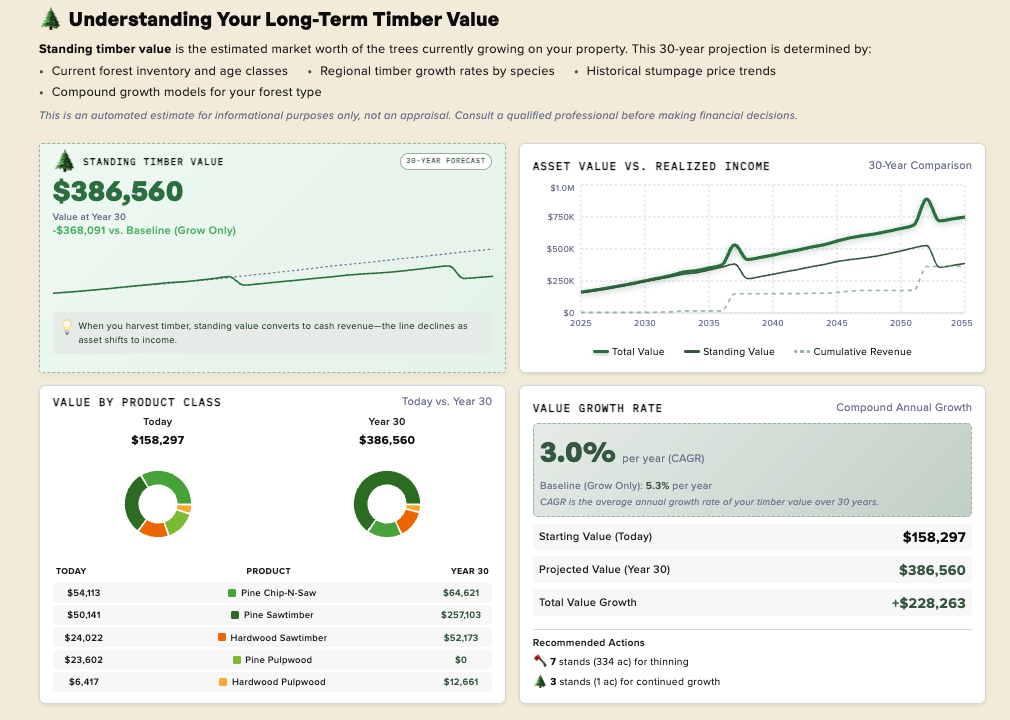
To see this view: Open Forest Forecast, select your goals, then click the Long-Term Forest Value metric to explore your 30-year projections.
What drives your forest’s appreciation
Five factors determine how quickly your forest gains value:
Tree size
Larger diameter trees command premium prices. A 14” tree may be worth 3x more per ton than an 8” tree of the same species. As your trees grow, they cross thresholds into higher-value categories.
Species mix
High-value species like white oak and longleaf pine appreciate faster than lower-value species. Your species composition affects both current value and long-term growth potential.
Thinning
Strategic thinning removes smaller, lower-value trees and accelerates growth on your best stems. It’s counterintuitive—removing trees can increase total value—but the remaining trees grow faster and reach premium sizes sooner.
Stand quality
Well-stocked, healthy stands with good form produce more sawtimber (trees large enough to mill into lumber) and less pulpwood (smaller trees destined for paper mills). Genetics, site quality, and past management all contribute.
Time
Patience pays. Each year of growth increases both volume and value per unit as trees mature. This compounding effect is why standing timber value often grows faster than you might expect.
The graduation effect in action
Here’s where it gets interesting. Trees don’t just grow—they graduate between product classes:
- Pulpwood (smaller trees destined for paper mills and chip plants—low value per ton)
- Chip-n-saw (mid-sized trees that yield some lumber plus wood chips—moderate value)
- Sawtimber (large trees milled into boards and lumber—premium prices)
Each graduation roughly doubles the value per ton. A forest heavy in pulpwood today might be worth 3-4x more in 15 years, not because you have more wood, but because you have more valuable wood. For a deeper look at how product classes affect value, see How Timber Buyers Decide What Your Trees Are Worth.
The detailed breakdown shows this shift with side-by-side comparisons: your product mix today versus your projected mix in year 30. For many properties, this reveals substantial hidden value that hasn’t matured yet.
What this means for your decisions
Understanding your forest as a growing asset helps you answer questions that harvest-focused thinking can’t:
-
What am I giving up by harvesting now? Your 30-year projection shows the appreciation you’d forgo. Sometimes waiting makes sense; sometimes it doesn’t. Now you can see the trade-off. (For help evaluating offers, see What’s a Fair Price for Your Timber?)
-
Is my forest actually growing in value? Not all forests appreciate at the same rate. Your growth projection shows whether time is working for you or against you.
-
How does management change the picture? Different management approaches—thinning to accelerate growth, harvesting for income, or letting it grow naturally—affect your 30-year trajectory differently. Compare pathways to see the impact.
See your forest as an asset
These insights are available now in Forest Forecast. To explore them:
- Log into your NCX account (or create one for free)
- Open Forest Forecast and select your goals
- Click the Long-Term Forest Value metric to see your 30-year projection
Unlike harvest revenue that comes and goes, standing timber value represents wealth that grows with your forest. Understanding both helps you make decisions that align with your goals—whether that’s maximizing income, building long-term value, or something in between.
All of this is available from your computer or phone—no site visit required. Have questions about your property’s long-term potential? Our forestry team can help you interpret your projections and explore your options over a call.
Schedule a Free Consultation
Forest Forecast was funded by a grant from the U.S. Forest Service.